
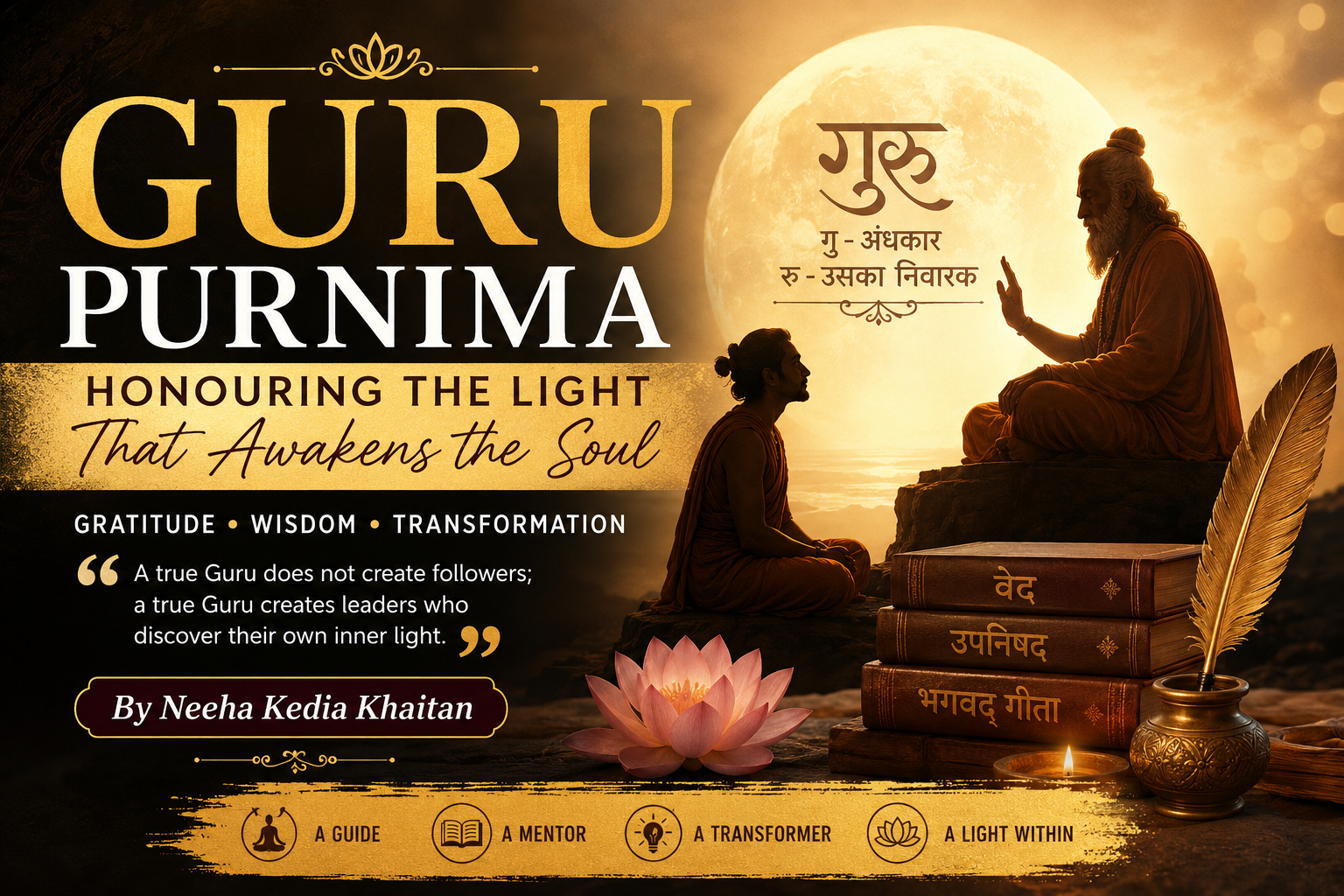
The word Guru originates from Sanskrit, where 'Gu' signifies darkness or ignorance and 'Ru' means the remover. Thus, a Guru is not merely an instructor who imparts information but one who dispels ignorance, awakens awareness, and inspires an individual to realise the light that already exists within.
«"A true Guru does not create followers; a true Guru creates awakened individuals who discover their own inner light."»
The Guru's Place Above All
The profound wisdom of Saint Kabir beautifully captures the significance of a Guru:
"Guru Govind dou khade, kake lagu paay?
Balihari Guru aapne, Govind diyo bataye."
The verse reminds us that if both God and the Guru stood before us, we should first bow to the Guru, for it is through the Guru's guidance that we come to know the Divine.
A Guru serves as the bridge between confusion and clarity, ignorance and wisdom, fear and faith. Without the right guidance, even the brightest destination can remain hidden from our sight.
The Origin of Guru Purnima
Ancient yogic traditions narrate the story of Adiyogi Shiva, regarded as the First Guru or Adi Guru. Thousands of years ago, after years of intense meditation in the Himalayas, seven sincere seekers dedicated themselves to learning from him. They practised with unwavering discipline for decades until, on the first full moon after the summer solstice, Shiva recognised their readiness to receive higher wisdom.
On this sacred day, he imparted the science of yoga and self-realisation to these seven disciples—the revered Saptarishis—who later carried this knowledge across the world. This historic moment is commemorated every year as Guru Purnima.
The day is also celebrated as Vyasa Purnima, paying homage to Maharishi Ved Vyasa, who compiled the Vedas and authored the Mahabharata, preserving India's spiritual heritage for generations.
Why Every Individual Needs a Guru
Guidance is essential in every sphere of life. A child learns to walk with support, an athlete succeeds through coaching, a musician grows under a teacher, and professionals evolve through mentors. Likewise, life's deeper journey requires someone who helps us understand ourselves.
A Guru does not simply provide answers. A Guru teaches us how to ask meaningful questions, think with clarity, and live with purpose.
«"Knowledge fills the mind; wisdom transforms the soul."»
The Psychology of Mentorship
Interestingly, modern psychology validates what ancient traditions have practised for centuries. Research consistently shows that people flourish when they have mentors who encourage growth, challenge limiting beliefs, and nurture confidence.
An effective mentor helps individuals:
- Build self-confidence
- Strengthen emotional intelligence
- Improve decision-making
- Overcome limiting beliefs
- Discover hidden potential
- Develop resilience during adversity
Psychologist Albert Bandura's Social Learning Theory explains that much of human learning occurs through observation and modelling. This mirrors the Guru-Shishya tradition, where disciples learn not only through instruction but through observation, discipline, and lived experience.
The Spiritual Role of a Guru
Spiritually, a Guru does not seek followers but seeks to awaken freedom. Rather than making disciples dependent, a true Guru empowers them to discover the truth within themselves.
Like a mirror reflecting our true image, a Guru reveals our highest potential without imposing it.
The Bhagavad Gita reminds seekers that wisdom is attained through humility, sincere enquiry, and dedicated learning under those who have realised truth.
«"The purpose of the Guru is not to make you dependent, but to make you free."»
A Guru Can Appear in Many Forms
While spiritual masters remain the most recognised Gurus, life's greatest lessons often come through unexpected teachers.
A Guru may be:
- A loving parent
- A dedicated teacher
- A supportive friend
- A compassionate counsellor
- A workplace mentor
- A life partner
- A child who teaches unconditional love
- Even failures and challenges that shape our character
Every experience that encourages us to grow becomes a teacher in its own right.
«"Every encounter in life is either a blessing or a lesson."»
The Guru Within
Ancient wisdom ultimately teaches that the highest Guru resides within every individual. External teachers guide us only until we awaken our own inner consciousness.
Through meditation, reflection, mindfulness, and sincere living, we begin to hear the quiet voice of wisdom already present within us.
The greatest Gurus never ask for worship—they inspire self-realisation.
«"The best teacher opens the door, but you must choose to walk through it."»
Living the Spirit of Guru Purnima
Guru Purnima is not merely about rituals or ceremonies; it is about embodying the teachings we have received.
We honour our Gurus by:
- Practising kindness
- Speaking truth with compassion
- Remaining lifelong learners
- Sharing knowledge with humility
- Expressing gratitude to everyone who has shaped our journey
Positive psychology also highlights gratitude as one of the strongest contributors to emotional well-being, stronger relationships, and inner resilience. Guru Purnima beautifully reminds us that gratitude itself is a profound spiritual practice.
Final Reflection
Throughout life, we seek light. Sometimes it comes through a teacher, sometimes through our parents, friends, mentors, challenges, or silent moments of introspection. Every guiding force that helps us evolve deserves our gratitude.
May this Guru Purnima inspire us to honour every soul who has illuminated our path, remain humble seekers of wisdom, and become guiding lights in the lives of others.
«"The greatest tribute to your Guru is not admiration—it is transformation."»
«"When knowledge enters the mind, you become educated. When wisdom enters the heart, you become awakened."»
«"A Guru does not change your destiny; a Guru transforms you—and you shape your own destiny."»
Happy Guru Purnima! May the blessings of every teacher—spiritual, academic, professional, and personal—continue to inspire wisdom, compassion, inner peace, and a life filled with purpose.