
Mumbai, July 14: India's benchmark equity indices, Sensex and Nifty, opened lower on Tuesday as investors reacted to a sharp rise in global crude oil prices and weak international market performance driven by escalating geopolitical tensions in the Middle East.
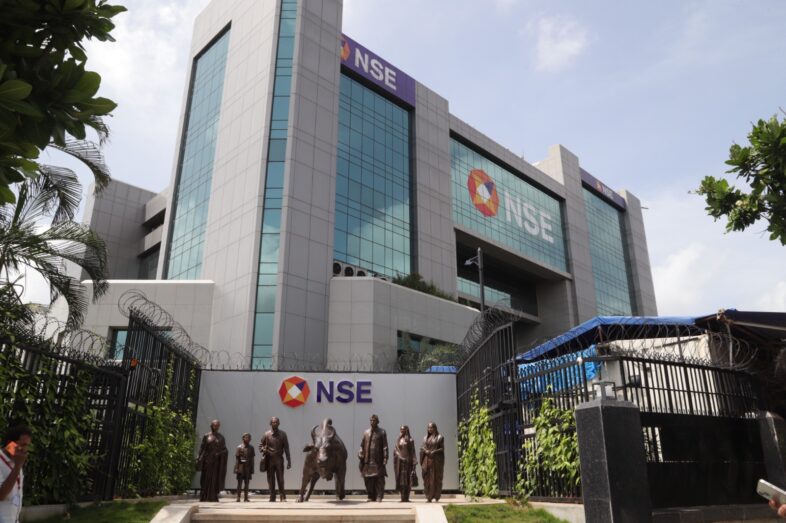
The BSE Sensex fell 344.06 points, or 0.44%, to open at 77,272.34, while the NSE Nifty declined by more than 100 points, or 0.59%, opening at 24,068.00. The cautious start to the trading session reflected growing concerns over rising energy costs and uncertainty in global financial markets.
Financial and automobile stocks led the market decline during early trading. The Nifty Financial Services Ex-Bank index dropped 1.12%, followed by the Nifty Auto index, which fell 1%. Other sectors, including private banking, real estate, and media, also recorded losses as investors remained risk-averse.
Despite the broader market weakness, metal and healthcare stocks showed resilience. The Nifty Metal index gained 0.38%, while the Nifty Healthcare index edged up 0.14%, indicating selective buying in defensive and commodity-linked sectors.
Among the major stocks, Shriram Finance, InterGlobe Aviation (IndiGo), Bajaj Finance, Larsen & Toubro, HCLTech, Mahindra & Mahindra, Kotak Mahindra Bank, and Bajaj Finserv were among the biggest decliners in early trade.
Market analysts noted that the recent surge in crude oil prices, driven by increasing geopolitical tensions, is likely to keep investors cautious in the near term. Although India's domestic economic fundamentals remain stable, sustained increases in oil prices could raise inflationary pressures and increase operating costs for fuel-dependent industries.
Experts identified 24,300 as an important resistance level for the Nifty and 24,000 as a key support level. A move above 24,300 could strengthen market momentum toward 24,530, while a fall below 24,000 may result in further downside toward the 23,800 support zone.
Global market sentiment also remained weak after continued military action involving the United States and Iran heightened geopolitical uncertainty. These developments pushed international crude oil prices higher, with Brent crude rising to $85.65 per barrel and West Texas Intermediate (WTI) crude climbing to $80.42 per barrel.
Asian markets also traded lower, with Japan's Nikkei, Hong Kong's Hang Seng, and South Korea's Kospi posting losses. In the United States, Wall Street ended the previous trading session on a negative note, with the S&P 500 and Nasdaq Composite closing lower.
Investors are expected to closely monitor global developments, crude oil prices, and upcoming economic indicators for further direction in the markets. Market participants remain focused on balancing near-term risks with the long-term strength of the Indian economy.