
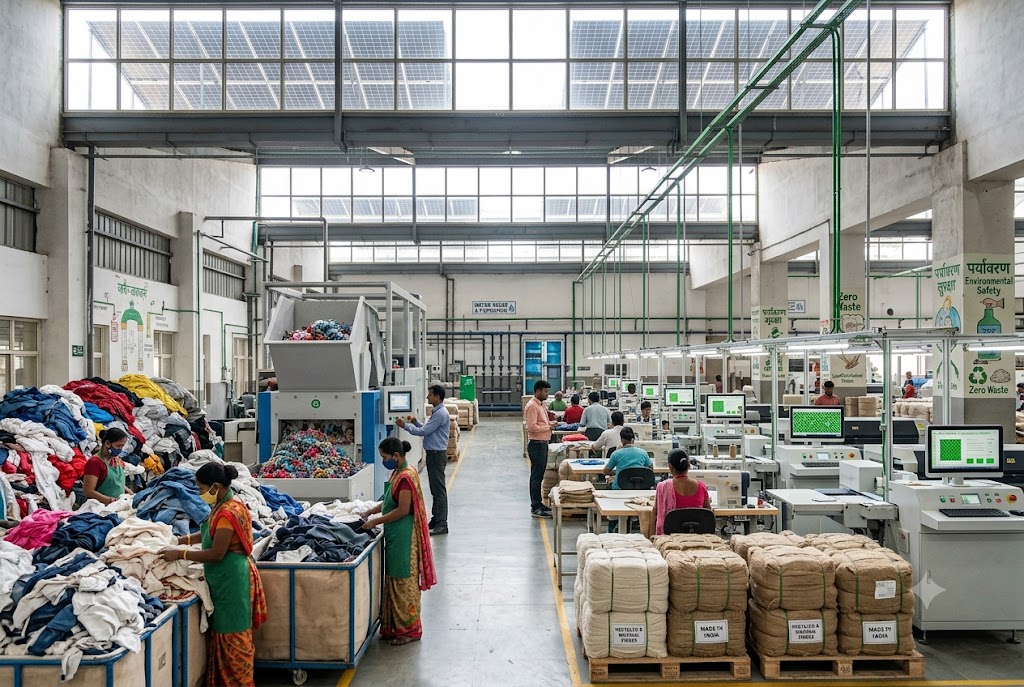
India’s fashion and textile manufacturing industry is entering a new phase where sustainability is moving from a corporate responsibility issue to a business and competitiveness issue. With the sector employing more than 45 million people and accounting for more than 4% of global textile and apparel trade, India has a major economic stake in how quickly its factories, suppliers and brands adapt to responsible production.
For decades, the industry's biggest advantages were its large workforce, established textile clusters, domestic raw-material base and export capabilities. Today, another factor is becoming increasingly important: the ability to produce fashion with lower environmental costs, better resource efficiency and stronger supply-chain standards.
This change is being driven by both opportunity and pressure. International buyers are paying greater attention to environmental performance, traceability and labour practices, while consumers are becoming more conscious of where and how their clothes are made. For Indian manufacturers, sustainability is therefore no longer simply about building a greener brand image. It is increasingly connected to market access, export competitiveness, operating costs and future investment.
Sustainability Is Becoming Part of the Cost of Doing Business
Fashion manufacturing uses large quantities of cotton, synthetic fibres, dyes, water, electricity and packaging. Inefficient use of these resources can increase production costs while creating environmental risks.
This is changing the business calculation for manufacturers. Investments in solar power, energy-efficient machinery, water recycling, cleaner dyeing processes and digital production technologies may require substantial upfront capital, but they can also reduce resource consumption over time.
For an industry operating on relatively tight margins, even small improvements in energy, water or material efficiency can have a meaningful effect on profitability.
This is particularly important as international buyers increasingly evaluate suppliers on environmental and social performance alongside price, quality and delivery. A factory that cannot meet evolving compliance requirements could find it harder to secure certain export orders, while manufacturers that can demonstrate credible sustainability practices may gain an advantage.
The Circular Economy Is Creating a New Textile Business
One of the most significant opportunities is hiding in something the industry has traditionally treated as waste.
India generates an estimated 7.8 million tonnes of textile waste each year, according to the figures provided. More than 70% is estimated to be recovered or recycled, indicating that a sizeable recycling ecosystem already exists.
The opportunity now is to make that ecosystem more organised, technologically advanced and commercially scalable.
Textile waste can become an input for recycled yarn, home furnishings, industrial textiles and other products. This creates business opportunities in collection, sorting, processing, fibre recovery and recycled-material manufacturing.
Panipat has already developed a major textile recycling ecosystem, demonstrating how waste can become an industrial raw material. Expanding similar capabilities in other textile clusters could create new enterprises and employment while reducing pressure on virgin resources.
The domestic textile recycling market is projected to reach around $3.5 billion by 2030, according to the figures cited in the background material. If the market develops as expected, recycling could become a meaningful new segment within India's broader textile economy.
However, scaling recycling will require investment in collection networks and technology. Blended fabrics, chemical finishes and complicated garment construction can make recycling difficult. Better product design and greater use of recyclable materials could eventually make the process more efficient.
MSMEs Face the Biggest Transition Challenge
The sustainability transition is likely to be most difficult for India's small and medium-sized textile businesses.
Large exporters can allocate capital towards renewable energy, wastewater treatment, certification, traceability systems and modern machinery. Smaller factories may struggle to make similar investments while dealing with limited working capital and intense price competition.
This creates a critical policy and business challenge. If sustainability standards become increasingly demanding without adequate financial and technical support, smaller manufacturers could find themselves squeezed out of global supply chains.
Affordable credit, shared testing facilities, common wastewater treatment infrastructure, technology-support programmes and industry-level training could make a significant difference.
There is also an opportunity for financial institutions. As manufacturers invest in energy efficiency, renewable power and waste-reduction technologies, demand could increase for specialised financing linked to sustainability improvements.
In other words, responsible fashion could create business opportunities not only for textile companies but also for banks, technology providers, equipment manufacturers, recyclers, consultants and logistics companies.
New Materials Could Change India's Textile Supply Chain
India's strength in cotton and traditional textile production provides a strong foundation, but the next phase of growth is likely to involve greater material diversification.
Organic cotton, jute and newer natural fibres such as flax, ramie and sisal can create opportunities in specialised fashion, home textiles and sustainable consumer products.
Jute is particularly interesting because India already has a significant production base and long-standing processing expertise. Expanding its applications beyond traditional products could create additional value for farmers, processors and manufacturers.
At the same time, recycled polyester and other recycled fibres could become increasingly important as brands seek to reduce dependence on virgin materials.
The opportunity is not simply to replace one material with another. Indian manufacturers can compete by developing fabrics that combine durability, performance, affordability and lower environmental impact.
This could move the country higher up the value chain—from being primarily a manufacturing destination to becoming a source of innovative textile materials and products.
Technology Is Changing the Factory Floor
Responsible manufacturing is also becoming a technology story.
Digital printing can reduce certain forms of water and chemical use compared with conventional processes. Automated cutting can improve material utilisation and reduce fabric waste. Solar installations can lower dependence on conventional electricity, while modern wastewater systems can allow water to be treated and reused.
These technologies have a second business benefit: they can improve productivity.
A factory that uses less fabric per garment, consumes less energy per unit of production or reduces production defects can potentially improve its margins while also lowering its environmental footprint.
This creates an important shift in the sustainability debate. Instead of viewing environmental investment purely as an additional cost, manufacturers are increasingly looking at it as a route towards operational efficiency and long-term competitiveness.
Global Trade Could Become the Biggest Driver
The international market may ultimately determine how quickly responsible production becomes mainstream in India.
Global fashion companies are facing increasing scrutiny over emissions, waste, labour conditions and supply-chain transparency. As international sustainability and product standards become more demanding, suppliers will need better systems for tracking materials, documenting processes and demonstrating compliance.
For Indian exporters, this creates both risk and opportunity.
The risk is that companies unable to meet new requirements could lose access to important customers. The opportunity is that manufacturers that invest early in compliance and traceability could become preferred suppliers.
This could encourage a broader wave of investment in modern factories, testing laboratories, certification services, supply-chain software and sustainable materials.
For India, that matters because textiles and apparel are highly employment-intensive industries. Greater export competitiveness can translate into factory investment, jobs and demand for supporting industries.
Responsible Fashion Can Support Rural and Local Economies
The economic impact extends beyond large manufacturing centres.
Cotton, jute and other natural fibres connect textile manufacturing with farmers and rural communities. Recycling connects factories with waste collectors and processing businesses. Garment production supports workers, transport operators, packaging suppliers and small service providers.
A more circular textile economy could therefore create income opportunities at several stages of the supply chain.
Traditional textile and craft clusters could also benefit if sustainability becomes part of their market positioning. Handloom, natural fibres and locally produced textiles can appeal to consumers seeking products with traceable origins, provided environmental claims are supported by credible practices.
The result could be a more distributed economic model in which value is created across farmers, artisans, manufacturers, recyclers and service providers rather than concentrated only at the final retail stage.
The Worker Question Cannot Be Ignored
Responsible production also has a social dimension.
India's fashion industry remains highly labour-intensive, and worker welfare will continue to influence the credibility of sustainability claims. Safe workplaces, appropriate wages, reasonable working hours and transparent employment practices are becoming increasingly important for both international buyers and consumers.
Subcontracting adds another layer of complexity. A brand or exporter may have strong formal policies, but ensuring those standards across multiple suppliers and subcontractors requires effective monitoring and documentation.
Improving labour standards can involve additional costs in the short term, but it can also reduce worker turnover, improve productivity and strengthen long-term supply relationships.
For an industry competing globally, responsible production therefore needs to cover both how products are made and how workers are treated.
From Compliance Cost to Competitive Advantage
The biggest change taking place in India's fashion manufacturing industry is perhaps psychological.
Sustainability was once often viewed as something companies did after meeting their core commercial objectives. Increasingly, it is becoming part of the commercial strategy itself.
A factory that saves energy can lower operating costs. A recycler can turn waste into revenue. A manufacturer using traceable materials can access buyers with stricter sourcing requirements. A technology company can sell solutions to factories seeking cleaner production. A financial institution can fund the transition.
This creates an entire ecosystem of economic activity around responsible manufacturing.
The challenge is ensuring that this transition remains commercially realistic. Sustainability standards that only large companies can afford may weaken smaller suppliers. On the other hand, weak standards can leave Indian manufacturers vulnerable to changing international requirements.
The most effective approach will combine clear regulations, industry collaboration, affordable technology and financial support for smaller enterprises.
The Next Chapter of Indian Fashion Manufacturing
India's textile and fashion industry has traditionally competed on scale, cost, craftsmanship and manufacturing capability. The next decade could add another competitive advantage: responsible production at scale.
The opportunity is substantial. A growing textile recycling market, expanding demand for sustainable materials, investment in cleaner factories and rising international compliance requirements could create new businesses across manufacturing, technology, finance, logistics and waste management.
But the transition will not happen simply because consumers want greener clothes. It will require investment, better infrastructure, skilled workers, reliable standards and business models that make sustainability financially viable.
For India, the prize is larger than producing environmentally responsible garments. It is the possibility of building a textile economy that is more resource-efficient, technologically advanced, export-ready and employment-intensive.
If the country can successfully combine its manufacturing scale with responsible production, sustainability could evolve from being a compliance requirement into one of the industry's most important sources of competitive advantage.