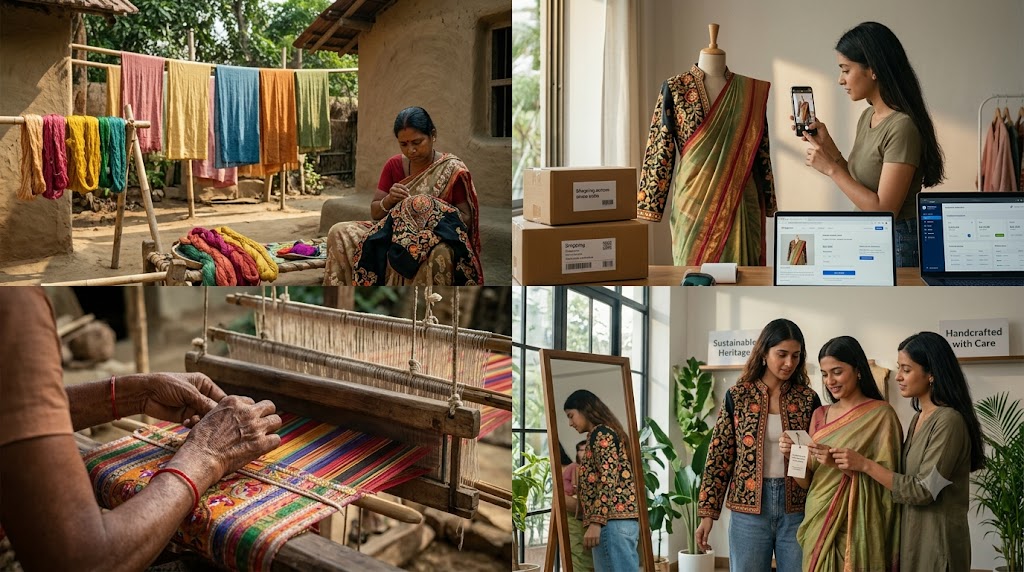
Indian fashion is changing, but it is not leaving its roots behind. Across the country, traditional crafts are finding new life as artisans, designers, technology and conscious consumers come together.
A handwoven sari, an embroidered jacket or a naturally dyed fabric may begin in a small village, but its journey can now reach customers across India and around the world. Digital platforms, modern retail and social media are giving regional crafts greater visibility, while growing interest in sustainability is encouraging consumers to think more carefully about what they wear and how it is made.
This meeting of craft and technology is creating a new chapter for Indian fashion — one that is modern, connected and still deeply rooted in its heritage.
From the Loom to the Digital World
Indian textiles have always carried stories.
A weaving technique can reflect the history of a community. A particular pattern can represent a region. Embroidery, dyeing and textile-making skills are often passed from one generation to another.
Yet, for many artisans, reaching customers beyond their local markets has remained a challenge.
Technology is gradually changing that.
Online marketplaces and digital storefronts are allowing regional products to reach customers far beyond traditional exhibitions and physical stores. Social media is also helping small brands and artisans showcase their work, build an audience and communicate directly with potential buyers.
For consumers, this creates a different kind of shopping experience. They are increasingly interested not only in how a garment looks, but also in where it came from and who made it.
Technology Supports the Artisan
The role of technology in traditional fashion is not necessarily about replacing human skill. Instead, it can help make that skill more visible and commercially viable.
Digital cataloguing, inventory systems, online payments, demand forecasting and product-tracking tools can help brands work more efficiently with artisan communities spread across different parts of the country.
Digital identification and QR-based systems can also provide consumers with greater information about certain handloom products and their origins.
This growing transparency can add value to genuine craftsmanship at a time when traditional designs can also be reproduced through mass production.
Technology, in this sense, becomes a bridge between the artisan and the modern customer.
India's Craft Economy Is About People
Behind India's textile and handicraft traditions are millions of people whose livelihoods depend on their skills.
The country's handloom sector alone supports millions of weavers and allied workers, while the wider handicraft ecosystem provides employment and income to communities across rural and semi-urban India.
For many families, craft is more than an occupation. It is part of their identity and cultural inheritance.
This makes the growth of India's craft-led fashion industry more than a commercial opportunity. It is also about creating sustainable livelihoods and ensuring that valuable traditional skills remain relevant for future generations.
When a handmade product reaches a wider market, the economic value can extend across an entire chain — from the artisan and designer to the retailer and consumer.
Sustainability Is Changing the Fashion Conversation
The way people think about fashion is changing.
Consumers are becoming more aware of clothing waste, excessive production and the environmental impact of the industry. As a result, there is growing interest in durable clothing, natural fibres, recycled materials, repair, reuse and more responsible production.
India has a unique foundation for this transition.
Many traditional craft practices are built around skilled manual work, careful material use and products designed to last. While handmade does not automatically mean sustainable, traditional techniques can offer valuable lessons for a fashion industry looking to become more responsible.
The opportunity now is to combine that traditional knowledge with modern approaches to sourcing, production, recycling and waste reduction.
Giving Traditional Craft a Contemporary Identity
Traditional fashion does not have to remain locked in the past.
Indian designers are increasingly experimenting with heritage textiles and presenting them in contemporary forms. A traditional weave can become a modern dress or jacket. Regional embroidery can appear on contemporary silhouettes. A textile once associated mainly with festive occasions can become part of everyday fashion.
This evolution can help keep traditional crafts relevant.
A craft survives when people continue to use it, wear it and value it.
Preserving heritage does not necessarily mean reproducing the same designs forever. It can also mean allowing artisans and designers to reinterpret traditional skills for a new generation.
The Rise of Decentralised Craft Networks
Another important development is the growing interest in decentralised production.
Rather than depending entirely on large manufacturing centres, fashion brands can work with artisan clusters, independent producers and specialised craftspeople across different regions.
Such networks can create opportunities in smaller communities while giving designers access to India's extraordinary range of textile and craft traditions.
Technology can help connect these different parts of the supply chain.
A designer in a major city can collaborate with a weaving community in another state. A regional artisan can sell to customers thousands of kilometres away. A consumer can discover the story behind a product with just a few clicks.
The distance between the creator and the customer is becoming smaller.
Young Consumers Want a Story, Not Just a Product
For many younger consumers, fashion is increasingly connected with identity, values and personal expression.
They may want to know where a product was made, what materials were used and whether the people involved in making it were fairly valued.
Social media has accelerated this shift.
A craftsperson who once depended largely on local markets can now introduce their work to a much wider audience. A small fashion label can build a following without opening dozens of physical stores.
The technology may be new, but the story being shared can be centuries old.
India's Opportunity in Global Fashion
India's textile and apparel industry is one of the country's important manufacturing and employment sectors. Its strength, however, goes beyond production capacity.
India has something particularly valuable in today's fashion market — an enormous diversity of craft traditions, textiles, techniques and cultural influences.
As consumers around the world show greater interest in authenticity, responsible production and distinctive design, Indian fashion has an opportunity to present its heritage in a contemporary way.
The challenge will be to expand the market while ensuring that artisans remain an important part of the value chain.
Where Heritage Finds Its Next Chapter
The future of Indian fashion may not lie in choosing between tradition and technology, but in bringing the two together thoughtfully.
Digital platforms can help artisans reach new markets. Modern design can give heritage techniques a fresh identity. Sustainable practices can make fashion more responsible. Technology can improve connections across a fragmented supply chain.
Yet, at the centre of it all remains the human hand — the skill, patience and creativity that give every handcrafted piece its character.
As Indian fashion moves towards a more connected and conscious future, its greatest strength may be its ability to move forward without leaving its heritage behind.
The loom, the artisan and the craft can remain rooted in tradition while their stories reach a new generation through technology.
That is where the real promise lies — not simply in making Indian fashion more modern, but in making its rich craft heritage more visible, valued and relevant for the future.