Fashion today moves much faster than it did a decade ago. Trends travel across borders within hours, consumers shop from international brands online and global retailers continuously reassess where their products should be manufactured.
For India, this changing fashion landscape presents both a challenge and an opportunity.
The country has a long history of textile production, a large workforce and access to major raw materials. Yet, when it comes to capturing a larger share of the global apparel business, India still has significant ground to cover.
A nearly $37-billion export industry
India's textile and apparel exports were estimated at around $35.52 billion to $37 billion in FY2026, with ready-made garments contributing approximately 44 per cent of the total.
Ready-made garment exports alone stood at about $15.77 billion, underlining the importance of finished clothing to India's international textile business.
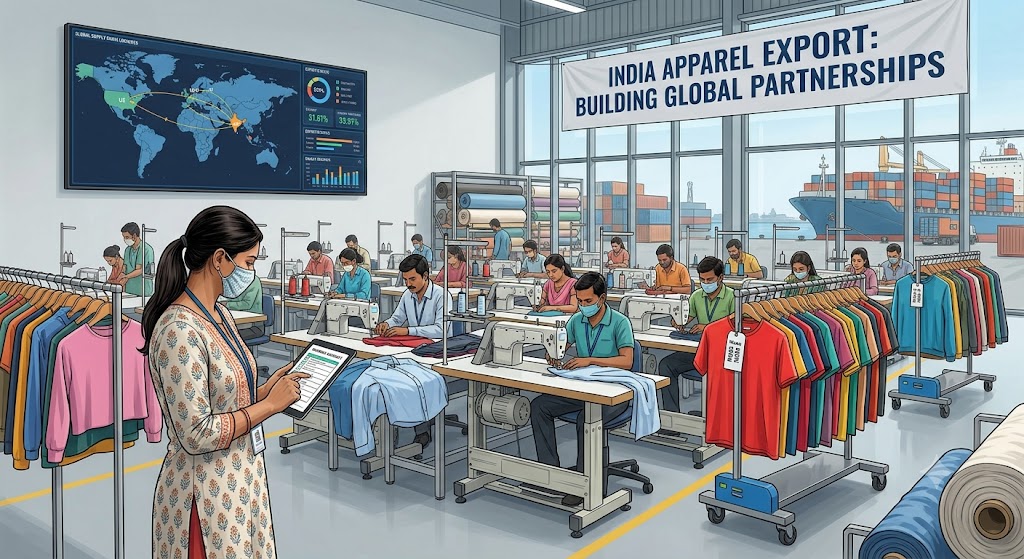
The numbers reflect the scale of an industry that extends well beyond garment factories. The wider ecosystem includes cotton and fibre producers, spinners, weavers, dyeing and processing units, garment manufacturers, designers, exporters, logistics companies and retail businesses.
For the fashion industry, this interconnected supply chain is one of India's biggest strengths.
The global opportunity remains much larger
Despite its large domestic industry, India accounts for only around 3-4 per cent of global textile and apparel exports. In apparel specifically, India's share is close to 3 per cent.
That relatively modest global presence is particularly significant at a time when international fashion companies are looking to diversify their manufacturing and sourcing networks.
China continues to be a dominant force in global apparel manufacturing, but its share of world apparel exports has declined over the years. The resulting shift has encouraged global brands to explore alternative production centres across Asia.
India is one of the countries with the potential to capture a greater portion of this business, but competition remains strong.
Why fashion brands are looking for alternatives
The global fashion industry is increasingly focused on supply-chain resilience. Disruptions, changing consumer demand, rising costs and geopolitical uncertainty have encouraged brands to avoid excessive dependence on a single manufacturing location.
This has created momentum behind the China+1 strategy, under which companies maintain China as an important production base while developing additional sourcing locations.
For Indian apparel manufacturers, this presents an opportunity to become part of more international supply chains.
However, global buyers are not looking only for low-cost production. They increasingly want suppliers that can deliver large orders consistently, meet tight deadlines, maintain quality and comply with environmental and labour standards.
That makes scale and efficiency critical for India's next phase of export growth.
Cotton remains a strength, but fashion is changing
India's strength in cotton gives the country an important advantage in global apparel manufacturing. T-shirts, shirts, knitwear and other cotton-based garments remain significant export categories.
Traditional and ethnic clothing also offers India a distinctive position. Sarees, kurtas, handloom products and silk garments have a strong cultural identity that can appeal to international consumers looking for distinctive fashion.
At the same time, global fashion demand is changing.
Sportswear, activewear, athleisure and performance clothing are becoming increasingly important. Much of this growth is driven by man-made fibres and technical materials.
For Indian manufacturers, expanding beyond conventional cotton apparel could therefore be an important part of moving into new segments of the global fashion market.
Trade agreements could reshape export opportunities
Market access is another factor that could influence India's apparel export prospects.
The United States, United Kingdom and European markets remain important destinations for Indian apparel. Better tariff access through trade agreements can improve the price competitiveness of Indian products and make it easier for exporters to compete with suppliers from other manufacturing hubs.
For businesses, the impact of lower tariffs can be significant. Apparel is a highly competitive industry where even a relatively small difference in landed cost can influence sourcing decisions by international retailers.
This makes trade agreements relevant not just at the policy level, but directly to the commercial decisions of exporters and global fashion companies.
The business opportunity extends beyond garments
A stronger apparel export industry could create opportunities across the wider textile ecosystem.
More garment orders can increase demand for fabrics, yarn, buttons, zippers, labels, packaging, textile machinery, warehousing and logistics. It can also encourage investment in manufacturing facilities and supply-chain infrastructure.
Large organised manufacturers could benefit from bigger international contracts, while smaller units could become suppliers to export-oriented companies.
This could gradually deepen India's position in global fashion supply chains.
Technology is becoming part of the fashion business
The modern apparel industry is also becoming increasingly technology-driven.
Automation, digital production planning, inventory management, data analytics and artificial intelligence are changing how fashion businesses forecast demand and manage their supply chains.
For exporters, technology can help reduce production delays, improve quality control and respond more quickly to changing fashion trends.
The ability to move from design to production faster could become particularly important as global brands shorten product cycles and consumers expect new styles more frequently.
Sustainability is no longer optional
Global fashion companies are also paying greater attention to sustainability and traceability.
International buyers increasingly want to know where materials come from, how products are manufactured and whether suppliers meet environmental and social standards.
This creates both a challenge and a business opportunity for Indian companies. Manufacturers that invest in energy efficiency, responsible sourcing, waste reduction, water management and transparent supply chains can strengthen their appeal to global buyers.
Sustainability is therefore becoming part of competitiveness rather than simply a corporate responsibility issue.
Building India's next fashion export story
India already has many of the foundations needed to become a larger player in global fashion: a sizeable textile ecosystem, skilled workers, raw-material availability, a large domestic market and an established export base.
The challenge is converting these advantages into greater global market share.
Industry bodies such as the Apparel Export Promotion Council (AEPC) support exporters through trade promotion and market development, while the Directorate General of Foreign Trade (DGFT) manages key export-related processes and schemes. The Ministry of Textiles also supports industry development through programmes covering manufacturing capacity, investment and textile infrastructure.
For businesses, however, the next stage will ultimately come down to competitiveness—better productivity, faster delivery, stronger product development, modern manufacturing and access to major international markets.
India's apparel story is therefore no longer simply about being one of the world's major textile producers. It is about becoming a larger and more reliable partner for the global fashion industry.
With apparel exports already worth billions of dollars and international brands continuing to rethink their sourcing strategies, the opportunity is significant. The real business question is how effectively Indian companies can turn that opportunity into sustained export growth.